
New Delhi: Following the conclusion of the 2026 World Cup final, Lionel Messi — widely regarded as the best player of his generation and potentially of all time — was observed sitting on the pitch with his legs extended in front of him, displaying a look of astonishment.
Event Context
In a World Cup final where one team bravely sought victory, the other opted for timid defense, casting a shadow over Lionel Messi’s final World Cup memory—and over Argentina’s legacy as well. This wasn’t the thrilling finale fans anticipated.
In hindsight, Argentina’s coach, Lionel Scaloni, may need to clarify his tactical choices after his team notably failed to register a shot on target throughout the match. According to Opta, it was the first time Argentina had gone without an attempt on target in a World Cup fixture since July 13, 2014, against Germany.
Argentina managed just two shots in this match, marking their poorest performance in terms of shot count at the 2026 FIFA World Cup. While Spain certainly commanded the match, it’s fair to wonder how the outcome might have differed if Messi and his teammates had taken more chances to attack.
Instead, the game played out with Spain controlling the tempo, relentlessly probing against an Argentine defense that held back. This was particularly surprising given Scaloni’s previous willingness to adopt a more aggressive style, notably in the semi-final against England. What led to this sudden shift? Was it a strategy aimed at taking the game to penalties?
Spain, who previously claimed the World Cup title in 2010, outperformed Argentina across virtually every statistic: they held 67% of possession compared to Argentina’s 33%, fired 20 shots to Argentina’s 2, and recorded 12 shots on target while Argentina had none. Spain also garnered more corners (9 to 4), though Argentina did commit slightly more fouls (25 to 21).
The 25 fouls by Argentina were the most in a World Cup match since they committed 26 fouls against France in the 2022 World Cup final. It raises the question of whether Scaloni thought this aggressive style might yield different results.
While Argentina attempted to disrupt Spain’s rhythm, they were not as effective as England had been in their earlier semifinal clash. Spain’s Rodri and his teammates remained resolute in sticking to their game plan.
“Of course, we wanted to secure victory sooner,” said Spain coach de la Fuente. “Martinez’s save thwarted our efforts, and while we pushed for a goal, we knew it was a World Cup final that required us to endure, even when facing ten men at the end. We relish that challenge, and I emphasize, we were ready for everything.”
Argentina’s manager expressed mixed emotions: “I feel sadness, but I know we gave it our all. I have much to say about our journey here, but now is not the time. I want to express my eternal gratitude to these players for delivering us to yet another World Cup final and competing fiercely until the end.”
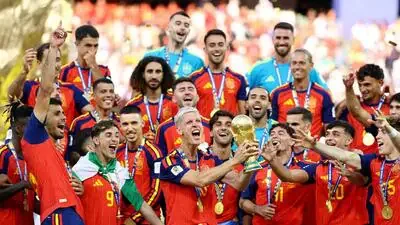
Currently, Spain stands tall as the first nation ever to simultaneously hold both the men’s and women’s World Cups. If there’s one takeaway from this final, it’s that their victory serves as a testament to the effectiveness of a well-established system, highlighting how teamwork can surpass individual brilliance.
Player Focus
Breaking through Argentina’s defense proved challenging, and when opportunities arose, they had to face the formidable Emiliano Martinez in goal. The Argentine goalkeeper made an impressive 12 saves before Torres ultimately sealed the victory. The goal had been anticipated for quite a while, and as the match entered extra time, thoughts of penalties began to ripple through the crowd.
Interestingly, the most remarkable aspect of the journey to the final was the path taken rather than the final result itself. As Wayne Rooney candidly remarked: “It was crap.” Despite having one of the most inventive players in the tournament and a legendary goal scorer on their side, Spain struggled to capitalize on this talent. Although Spain effectively limited passing options, Messi still had some magic left to offer.
Torres, who entered the match in the 62nd minute and went on to score, described his goal as destined, but it was clear that it represented something greater.
“In the end, the goal belonged to 47 million people—not just to me or the 26 players on the field. I believe the result was fated; we were meant to win this match, even if we were far from our supporters. We did our utmost to bring them closer to us. Every final is tough, especially when facing a team with Messi—nerves always set in. However, we remained committed to our style of play, and I think we demonstrated that once again today.”
Team Analysis
Determining the root of Argentina’s defeat is complex. Did it stem from Spain’s narrow 1-0 win, with Ferran Torres scoring during extra time, or from Argentina’s passive performance? As defending champions, Argentina had previously discovered ways to secure victories, but they faltered at a crucial moment when resilience was needed most.
“There’s immense pride. Pride in this generation of players who have embraced this vision, remained committed to it, and given their all,” remarked Spain’s manager, Luis de la Fuente, after the match. He accurately reflected the situation.
Argentina, however, appeared to lack the necessary spirit. Coach Lionel Scaloni attempted to rationalize his team’s performance but struggled to convey his point.
He stated, “Spain played better, and that’s the reality. Yet, I will cherish the significant memory of our journey to this point. Achieving this level is commendable and should be valued highly. In both triumph and defeat, we must uphold our dignity. Today, we acknowledge our loss, but that won’t diminish the remarkable feats that led us here.”
