
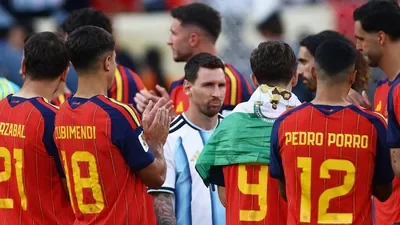
Following their tactical brilliance in the semifinal against France, Spain boldly referred to themselves as ‘unbeatable.’ This declaration stemmed not from arrogance or empty confidence, but from a genuine belief in their capabilities.
Event Context
Luis de la Fuente’s squad largely went unnoticed during the World Cup until they shocked the tournament favorites, France, in Dallas. With each match, they improved significantly, ultimately becoming the most well-rounded team in the competition. After toppling the tournament’s most daunting offense, they avoided falling into Argentina’s trickery during the final.
In the end, as Toni Kroos aptly stated, ‘Football won.’
Spain dominated Argentina from the very beginning at MetLife Stadium in New York, where the majority of the 80,663 fans had come hoping to see Lionel Messi secure the World Cup one last time.
However, it was substitute Ferran Torres who made his mark by scoring just 37 seconds into the second half of extra time—his first goal of the tournament after 14 attempts—securing a 1-0 victory and Spain’s second World Cup title, their first since 2010.
Spain charged forward with the first 20 shots of the game, while Argentina did not register their first effort until the 118th minute, a moment of desperation in place of patience. Even with the defending champions down to 10 men by then, Argentina could only muster two attempts, neither of which tested goalkeeper Unai Simon.
Having been booked early for dissent after arguing against a challenge on Rodri, Fernandez earned a second yellow card late in added time for a reckless challenge on Pau Cubarsi, leaving Argentina short-handed before extra time.
Rodri delivered an exceptional performance in the final, consistently intercepting passes, anticipating Argentina’s movements, and controlling the game’s pace. Each time Argentina attempted to push forward, Rodri was there to halt their progress.
By the conclusion of normal time, Messi was largely uninvolved, Argentina had not taken a single shot, and Spain maintained complete dominance in the World Cup final.
How Spain silenced Messi
Spain concluded the tournament with an impressive defensive performance, allowing only a single goal in eight matches. Their style of play emphasized a compact, possession-based approach that relied less on individual talent, including that of Lamine Yamal. Mirroring their strategy from the 2010 World Cup in Johannesburg, Spain stifled a challenging opponent before delivering a decisive blow in extra time.
Lionel Messi, who had been instrumental in Argentina’s journey to the final with a tally of eight goals and four assists, found himself largely ineffective during the match. Argentina opted to slow the pace of the game, disrupting Spain’s flow and appearing willing to take the match to penalties. However, once Ferran Torres scored, Messi began to show signs of life.
For a moment, it felt reminiscent of past performances.
Argentina had previously netted three goals in just 13 minutes against Egypt, and Messi had been a hero in their quarterfinal victory over Switzerland. Yet Spain was fully prepared to counteract such situations.
By maintaining possession and quickly regaining the ball whenever they lost it, Spain effectively severed Messi’s connections to the game.
Thierry Henry accurately captured the feeling on Fox Sports: “It’s like having your head underwater. You feel suffocated.”
Spain utilized a notably high defensive line, compressing the field and forcing Messi to receive the ball in less threatening positions. Whenever he attempted to maneuver into space, Rodri was right there to clamp down on him.
In a bid to find more space, Messi shifted to the right flank, a tactic that had previously caused issues for teams like England and Egypt in the tournament. Spain, however, tracked him closely, ensuring he was crowded out before he could make an impact.
Just days prior in Atlanta, Enzo Fernandez had celebrated his semifinal goal against England by mimicking Juan Roman Riquelme’s iconic pose.
In New York, however, he faced a night to forget.
Lionel Scaloni initially repositioned Julian Alvarez deeper on the field to counter Spain’s dominance. Nevertheless, as Spain tightened their control, he was compelled to bring on an additional defender, which left Messi increasingly isolated in attack.
Argentina found themselves clinging to faint hopes.
In their encounter with France, Rodri effectively managed the midfield and subdued Michael Olise.
Ultimately, it made little difference. Rodri continued to direct a relentless flow of play toward Argentina’s goal.
Team Analysis
The final score did not truly represent Spain’s clear superiority in the match.
Spain fully merited their victory.
Lionel Messi ended the game with only 54 touches, failing to enter Spain’s penalty area at all. Remarkably, he did not create any scoring opportunities, marking just the third instance of this in a major tournament.
While England contemplated applying man-marking on Messi, they never fully committed to the strategy. In contrast, Spain effectively limited his influence by cutting off his access to the ball.
This led to rising frustration from Argentina. Leandro Paredes received a yellow card for an elbow into Rodri’s back, highlighting the lengths to which Argentina went to try and disrupt Spain’s midfield orchestrator.
