
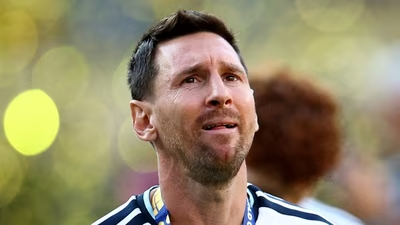
As Lionel Messi entered the 2026 World Cup final, he carried a legacy of remarkable achievements. However, he left the pitch with a runner-up medal after a challenging 120 minutes against Spain, a match during which he set several records simply by taking to the field, yet saw many personal milestones slip away.
Event Context
Ferran Torres’ goal in the 106th minute clinched a 1-0 victory for Spain at the New York-New Jersey Stadium, bringing an end to Argentina’s championship reign and preventing Lionel Messi from securing a second consecutive World Cup title—an achievement that would have further elevated his already legendary career. Spain dominated the final, launching the first 20 shots before Argentina managed their first attempt in extra time. Despite Emiliano Martinez making a tournament-record 12 saves, the defending champions could not force a penalty shootout.
For Messi, this defeat was about more than just losing a trophy. At 39, and potentially in his final World Cup match, he had the opportunity to break records related to captaincy, age, goals, and the tournament’s most prestigious individual awards. Victory would have made Messi the only player to win two World Cups as captain.
Having lifted the trophy in Qatar in 2022, he aimed to be the first captain to retain the title. While several players have won two World Cup medals, no one has led their nation to victory twice. Argentina was also vying to become the third nation to win back-to-back World Cups, following the footsteps of Italy in 1934 and 1938, and Brazil in 1958 and 1962. This would have positioned Messi as the captain of the first team to defend its title in 64 years.
Entering the final, Messi was already the only player to secure the Golden Ball more than once, having received it in 2014 and again in 2022. Winning the Golden Boot would have created a unique achievement in World Cup history. A strong performance could have also earned him a record third Golden Ball, making him the first player to capture the award in consecutive tournaments and extending his own record from two to three wins. Instead, the honor went to Spain’s captain Rodri, while Kylian Mbappe claimed his second consecutive Golden Boot.
Scoring in the final would have seen Messi become the oldest player to score in a World Cup final, surpassing Sweden’s Nils Liedholm, who was 35 years and 264 days when he netted against Brazil in 1958. Messi had previously scored twice in the 2022 final against France. Finding the net against Spain would have placed him among just six players to score in two different World Cup finals, but as the captain, he would have uniquely achieved this feat.
Despite the loss, Messi still made history by starting the match. He became the first player to participate in three World Cup finals and the first to captain a team in three tournaments. Additionally, he became the oldest outfield player to feature in a final.
Goals that would have rewritten World Cup history
Had Messi scored in the final, he would have made history as the oldest outfield player to win the World Cup at 39 years and 25 days, surpassing Nilton Santos, who was 37 during Brazil’s 1962 victory. Dino Zoff, the goalkeeper and captain of Italy’s 1982 champions, remains the oldest winner overall at 40.
The Golden Boot was one of the few accolades missing from Messi’s illustrious career. With Kylian Mbappe netting two goals in the third-place match, he brought his tournament total to 10, placing him two goals ahead of Messi. To claim the top scorer title, Messi needed a hat-trick; a two-goal performance would have left them tied, with assists and minutes played serving as tiebreakers.
If Messi had surpassed Mbappe, he would have become the oldest winner of the Golden Boot in World Cup history. Furthermore, he would have been the first player ever to win both the World Cup Golden Ball and the Golden Boot.
Winning both awards would have granted Messi an extraordinary collection of three Golden Balls and one Golden Boot.
Starting the final with 21 career World Cup goals, Messi was just one goal behind Mbappe, who had scored 22 in the bronze-medal match. Scoring just once would have tied him with Mbappe for the tournament’s all-time leading scorer; two goals would have reclaimed the top spot for Messi. However, he ended the match without finding the net, leaving Mbappe at the pinnacle.
A goal would have also broken Guillermo Stabile’s 96-year-standing record for the most goals in a single World Cup for Argentina. Stabile netted eight goals in 1930, while Messi entered the 2026 final with the same tally. Scoring one more would have given Messi nine goals, establishing a new national record.
If his goal had contributed to an Argentina victory, Messi would have eclipsed Ronaldo Nazario’s record for the most goals by a player in a single tournament for the eventual champions. Ronaldo scored eight times during Brazil’s successful 2002 campaign.
Collectively scoring two would have equalled Mbappe’s record of four goals in World Cup finals. A hat-trick would have set him apart with five and would have simultaneously secured him the Golden Boot and the all-time career scoring record.
However, these record opportunities faded as Spain’s defense effectively contained Argentina, resulting in Torres scoring the only goal of the match.
Consequently, the night marked a rare moment in Messi’s World Cup journey, characterized by the records that eluded him: a second title as captain, the ever-elusive Golden Boot, a third Golden Ball, the all-time scoring lead, and the opportunity to become both the oldest goalscorer and oldest outfield champion in World Cup history.
