
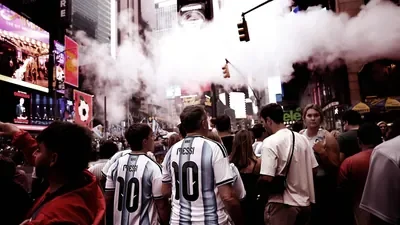
As the referee officiates the match at MetLife Stadium in New Jersey this Sunday, a subtle yet synchronized atmosphere will unfold across various time zones. In a flat in Delhi, a mobile phone might be gently placed screen-down. Meanwhile, in a bar in Buenos Aires, the volume of an overhead television is likely to rise. Over in a café in Casablanca, patrons may arrange their chairs closer together around a displayed screen.
Event Context
For the next 90 minutes — and potentially longer if extra time and penalties are involved — the everyday activities of the world may shift, dim, or even come to a halt as a football match takes center stage. The impact of this event is increasingly quantifiable, as various sectors including broadcasters, utility providers, hospitals, police, stock markets, and maternity wards have documented patterns during significant tournaments. Collectively, these records illustrate a unique phenomenon: during a FIFA World Cup final, global attention converges on a single event like no other.
Viewership skyrockets, energy consumption surges, and water usage peaks at halftime, while traffic slows and crime rates drop. FIFA’s official reports from Qatar 2022 revealed that the final between Argentina and France attracted 1.42 billion viewers who engaged with at least a minute of the live broadcast, with an average concurrent audience of 571 million — the largest single-event television audience recorded by the organization.
Throughout the tournament, approximately five billion people connected with the World Cup in various ways, with Asia and Oceania making up 2.59 billion interactions. In India alone, 745.7 million interactions were registered. Jio Cinema, which held streaming rights for the tournament in India, reported that the peak concurrent viewership during the final reached 32 million, marking the platform’s highest live sports audience to date. The total watch time across its Sports18 channel and OTT platform exceeded 40 billion minutes during the tournament.
In the UK, this collective focus reveals a distinct pattern. The National Energy System Operator (NESO) has been monitoring electricity demand during televised football for decades, anticipating the significant national demand spikes as millions of viewers boil kettles at halftime and full-time. This phenomenon is known as ‘TV pickup.’ NESO estimated that each group-stage match featuring England or Scotland would prompt a pickup of about 600 megawatts, equivalent to the combined electricity usage of both cities at any moment.
The highest recorded surge linked to a football event was 2,800 megawatts, following England’s semi-final loss to West Germany in 1990. During the 2022 World Cup, the quarter-final match between England and France resulted in a 914-megawatt increase at halftime.
Water companies observe similar patterns as restroom usage spikes during match breaks. For instance, on June 19, 2018, during Japan’s 2-1 victory over Colombia in the Russia World Cup, the Tokyo Waterworks Bureau noted a 24% increase in water consumption at halftime and a 50% surge by full-time. Officials indicated they adjusted water supply and pressure in anticipation of these fluctuations.
Similarly, the New York City Department of Environmental Protection records comparable trends during the Super Bowl.
The professional impact of such events is also significant. Challenger, Gray & Christmas, an outplacement firm that has analyzed productivity disruptions from major American sporting events for twenty years, projected that if every employed American football fan took a day off to watch a significant match during the 2026 World Cup, it could cost US employers up to $30.2 billion. Even one hour of distraction could cost around $4.4 billion. Challenger emphasized that this projection serves as a broad estimation of disruption potential rather than a precise prediction of absenteeism. ‘Smart employers will adapt to this reality,’ said Andy Challenger, the firm’s chief revenue officer. ‘They’ll integrate it into the work schedule.’
A workforce-management study by UKG, which surveyed 8,000 employees across eight countries, found a projected global productivity loss of $17 billion. Behavioral insights revealed that 37% of respondents intended to modify their schedules during the 2026 World Cup, 27% anticipated missing work, 14% planned to secretly stream matches, and 11% expected to work while hungover.
During the hour leading up to England’s group match against Slovenia in the 2010 World Cup, vehicle usage dropped by 49%, and traffic remained below normal levels throughout the afternoon. Similarly, reports indicated that crime rates tend to decrease. On June 11, the day Mexico kicked off the 2026 World Cup against South Africa, the country recorded 30 homicides, significantly lower than the daily average of over 70.
In the US, Atlanta police noted an 8% decline in overall crime in downtown areas during the tournament’s first week. Kansas City prosecutors observed a reduction in police-referred cases from 536 the previous year to 420 during the same timeframe.
A study published in the New England Journal of Medicine tracked cardiovascular emergencies in the greater Munich area during the 2006 World Cup. Researchers found that the rate of cardiac incidents on match days was 2.66 times higher than during non-match days, with men showing a 3.26 times increase and women a 1.82 times increase. The peak incidence occurred within two hours of kick-off.
A systematic review in 2024 by Gwinyai Masukume and colleagues highlighted various World Cup-specific findings. In South Africa, the 2010 World Cup correlated with over 1,000 additional live births nine months later compared to historical averages. Conversely, a decline in births was observed in provinces of Spain after popular local teams faced upset defeats from 2001 to 2015. However, claims of a baby boom in Iceland following Euro 2016 did not hold up under scrutiny.
With an estimated one to two billion individuals expected to watch the 2026 World Cup final live, and FIFA anticipating approximately six billion interactions with the tournament overall, the 90 minutes at MetLife Stadium could represent the closest modern society comes to a synchronized pause in activity. Not complete silence, but rather a shared, collective moment of anticipation and breath-holding.
Player Focus
In related news, Lionel Messi is set to go head-to-head with Lamine Yamal in what is anticipated to be one of football’s most remarkable generational clashes at the World Cup 2026 final.
A pivotal study released in the Christmas 2013 issue of the BMJ by Jesus Montesinos and his team from Catalonia analyzed 11,000 births recorded at two hospitals between 2007 and 2011. They discovered a 16% rise in births in February 2010 and an 11% increase in March 2010 compared to those months in previous years. This spike coincided with a thrilling series of FC Barcelona victories in 2009, notably Andrés Iniesta’s dramatic goal against Chelsea. Initial reports from Spanish media suggested a 45% increase, though the peer-reviewed analysis indicated a smaller, yet statistically significant, figure.
Team Analysis
To mitigate electrical surges, the power grid relies on Dinorwig, a pumped-storage facility located within a mountain in Snowdonia, Wales. During times of low demand, water is stored by pumping it uphill, and it is released through turbines when demand spikes. This process can shift from standby to maximum output in just 12 seconds.
In cities near stadiums, traffic congestion is common. Conversely, during matches featuring a home team, many roads become deserted.
Cybit, a fleet-telematics company in the UK, tracked over 50,000 commercial vehicles in real-time, providing a clear indication of this traffic change.
The researchers noted that the emotional strain related to national team matches might be a key factor in these patterns; however, their findings were primarily based on data from host-country populations in Munich. It remains unclear if these effects can be applied to other countries on the same scale.
An additional consequence was observed about nine months later in maternity wards.
Match Outlook
The department highlighted three key moments each year when synchronized toilet flushing occurs: the start of the halftime show, the conclusion of the halftime show, and the end of the game. During Super Bowl LVIII, which took place in the 2023 season, the increase in post-game toilet flushes was estimated to be equivalent to an additional 467,881 flushes.
