
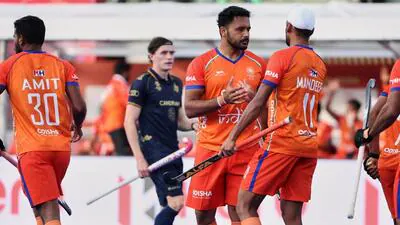
New Delhi: As the Indian men’s hockey team touched down in Japan last week to defend their Asian Games title, it would have filled the players with confidence after the recent disappointment of an eighth-place finish in the World Cup.
Transitioning an elite squad from the physical and emotional cauldron of a World Cup into a high-stakes continental championship in 19 days – gap between the events—is a massive challenge. The structural and psychological recalibration fell largely on the shoulders of scientific advisor Alan Tan, who had to put together an expedited recovery programme the moment India’s World Cup campaign ended, on August 28. “We had given the players up to 3-5 days completely off immediately after their last World Cup game.
The week home is for them to decompress from the World Cup, spend time with their loved ones and get back to strength and speed,” Tan told HT.
The defence remains the team’s anchor and primary set-piece engine. Spearheaded by captain Harmanpreet, whose world-class drag-flicking remains India’s most potent weapon, the backline features defensive steel in Jarmanpreet Singh, Amit Rohidas, Jugraj Singh, Sanjay, Sumit, and young prospect Yashdeep Siwach. Rohidas and Jugraj provide variation in penalty corners (PC) while Sumit and Jarmanpreet offer dynamic outlets to escape high opposition presses.
“The game has evolved into a hyper-fast sport driven by rapid ball movement and positional awareness,” Sardar told HT. However, maintaining physical sharpness during the World Cup itself had laid the groundwork for Asiad. Gym during the World Cup allowed Tan’s team to integrate micro-dosing strength sessions on match days, a modern conditioning methodology that preserves power and neural activation without accumulating systemic fatigue. India’s midfield represents a blend of creative flair and defensive work rate. Manpreet, India’s most-capped player, brings tactical intelligence and big-game composure. Beside him, Hardik Singh serves as the team’s engine, orchestrating transitions with dynamic lateral movement. The line-up is further bolstered by the creative distribution and pressing intelligence of Rajinder Singh, Raj Kumar Pal, Nilakanta Sharma and Vivek Sagar Prasad. “Players no longer have the luxury of stopping to survey options. Passing lanes and defensive shifts must be executed instinctively, like a seamless Bluetooth connection forged through eye contact and relentless training habits. Harmanpreet echoed Fulton’s philosophy of methodical execution, emphasising that the squad must focus strictly on one match at a time rather than look ahead to the final or Olympic scenarios.
