
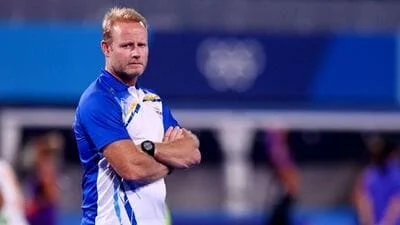
NEW DELHI: The Indian women’s hockey team is approaching a crucial period, marked by the proximity of two significant tournaments.
Event Context
For chief coach Sjoerd Marijne, the World Cup (August 15-30) and the Asian Games (September 19-October 4) create a complementary path towards their primary objective. The World Cup serves as a challenging arena against the world’s best teams, while excelling at the Asian Games ensures a vital reward — direct qualification for the 2028 Los Angeles Olympics.
Marijne emphasizes that the World Cup is more than just a preparatory event. Competing in this prestigious tournament requires unwavering concentration, and these intense matches are crucial for building the resilience his players will need for the Asian Games in Japan.
“The World Cup is still important for us because it prepares us for the Asian Games. You only get to play in a World Cup once every four years, and we want to perform well. I believe we can succeed at both, as I witnessed in 2018 when we thrived in a similar schedule,” said the 52-year-old coach.
Since joining the team in January, Marijne has guided the Salima Tete-led squad to achieve significant milestones. The team secured their place in the World Cup by winning the Qualifiers in Hyderabad in March, followed by a triumph in the Nations Cup in Auckland in June, which granted them promotion to the Pro League.
The chief coach asserts that there is sufficient time for recovery between events, highlighting that “one tournament will benefit the other.”
However, before focusing on aspirations for a medal at the Asian Games, India must navigate a challenging group stage at the World Cup. They find themselves in a tough group alongside the silver medallists from the Paris Olympics, China, the England team that won gold at the Rio Olympics, and world No. 18, South Africa. Only two teams will advance, making qualification a daunting task for the world No. 9 side.
“It’s a very competitive group,” Marijne noted. “From a rankings perspective, we need to secure a victory against South Africa since they’re ranked lower, while the other two teams are above us.”
Matches against England and China will be crucial indicators of the team’s progress. India faced England in the World Cup Qualifier final, where they performed well but felt they could have achieved more. The match against China, silver medallists at the Paris Olympics, will also pose a significant challenge ahead of the Asian Games.
With a clear vision in place and collective ambition replacing any internal conflict, the World Cup stands as the pivotal arena where their destinies will be shaped.
Player Focus
“I have a high regard for both tournaments,” Marijne shares with HT. “However, the Asian Games hold significant importance as it offers a pathway to Olympic qualification, which is our primary focus — to secure a medal at the 2028 Olympics. That’s our ultimate aspiration. Whether we can achieve it is uncertain, but we are actively pursuing it. A critical first step is to qualify.”
“We need to maintain our defensive structure and discipline. Ultimately, success in major tournaments hinges on converting opportunities into goals. While we’ve excelled with penalty corners, there’s still room to improve our conversion of chances from open play,” he added.
Team Analysis
To close the performance gap, Marijne has spearheaded a cultural transformation within the team. Prior to his tenure, the squad faced significant unrest and divisions. Achieving a unified team necessitated diminishing individual egos and promoting a shared sense of purpose. “It’s essential to prioritize team unity and focus on collective objectives rather than personal aspirations.” This newfound cohesion has led to a disciplined, task-oriented approach. As the team concentrates on building a solid defensive framework, Marijne recognizes that the margins for success are extremely narrow.
Match Outlook
Facing this double-header demands not only strategic accuracy but also foresight. Marijne fully understands the delicate balance his team must achieve. When questioned about priorities, the Dutch coach maintained that neither match holds less significance, seeing them as linked milestones in their journey.
“China represents a unique challenge,” Marijne notes. “They’ve shown impressive form over the past few years, making them our toughest test. We face them first on August 16, which will provide us with valuable insight into our current standing against the world’s No. 4 team. We’ll find out if the gap has closed, widened, or stayed the same—though we certainly hope for the former.”
However, the nature of international hockey is that chances can be scarce. “Against higher-ranked opponents, you won’t have numerous opportunities; you might see two or three clear chances, and you need to convert at least one or two of those. If you receive a few penalty corners, converting one or two is key to securing victories,” Marijne explains, recalling his experience leading the team to a fourth-place finish at the 2021 Tokyo Olympics.
