
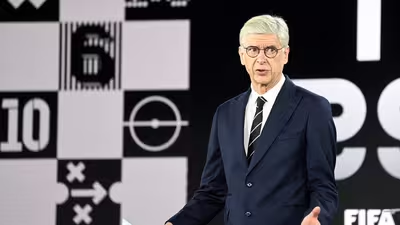
Arsene Wenger has clarified his non-involvement in Gianni Infantino’s unsuccessful initiative to attract private investors to FIFA’s commercial operations. He emphasized that he only became aware of this controversial project through news coverage. Since November 2019, Wenger has held the position of FIFA’s Chief of Global Football Development. On Tuesday, he released a statement as the repercussions from the halted FIFA Forward Enterprise proposal continued to impact the organization.
Wenger says he learned of FIFA plan through media
The former Arsenal manager faced scrutiny for his lack of comments due to his prominent role within FIFA. In a clarifying statement, Wenger emphasized that his duties pertain strictly to the technical and developmental aspects of football, not its commercial strategies.
Gianni Infantino proposed the creation of FIFA Forward Enterprise, a subsidiary tasked with managing FIFA’s commercial and event activities. There was consideration to sell a non-controlling 20% stake in this entity to private investors, which could potentially generate around $4.2 billion.
The initiative faced significant backlash as numerous confederations and national football bodies suggested they hadn’t been adequately consulted. UEFA, the Asian Football Confederation, and CONCACAF were among those voicing concerns, leading several European associations to rescind their support for Infantino’s re-election.
Following the outcry, Infantino chose to withdraw the proposal, yet this dismissal did not resolve the ongoing crisis surrounding his leadership. UEFA expressed its loss of confidence in the FIFA president and began exploring possible legal avenues regarding the matter.
Breaking his silence, Wenger defined his role at FIFA and expressed strong support for the decision to discontinue the proposal. “These recent developments at FIFA require my clarification,” Wenger stated. “As FIFA’s Chief of Global Football Development, I and my team manage the game’s data analysis, the FIFA online training platform, youth education initiatives through 60 academies in countries most in need, and oversee global youth competitions.
Furthermore, I serve as a technical adviser to IFAB. I was not involved in the strategic planning and first learned about the initiative through media coverage. The choice to withdraw from this project was not only necessary but indisputable, as I firmly advocate for an independent FIFA that upholds the game’s commitment, transparency, and integrity.”
Wenger’s statement marks a notable public divergence from Infantino concerning the management of the initiative. Although he did not call for the FIFA president’s resignation or indicate his own exit from the organization, Wenger made it clear he was neither part of the proposal’s development nor in favor of its advancement.
His remarks add pressure on Infantino ahead of FIFA’s presidential election scheduled for March 2027, with the English and Welsh football associations among the European bodies withdrawing support for his reelection amid the controversy.
Additionally, key figures within FIFA have also sought to dissociate themselves from the scrapped plan. What began as a dispute over private investment has escalated into broader concerns regarding transparency, consultation, and Infantino’s authority in global football.
