
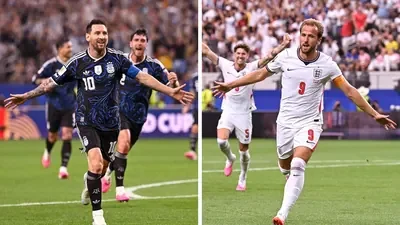
The first semifinal match is complete, and attention now shifts to the second. In a tactical showcase in Dallas on Tuesday, Spain outplayed France and will now face the winner of Wednesday’s highly anticipated clash between defending champions Argentina and England in Atlanta.
Where the semifinal will be won
Argentina’s journey to the semifinals has been marked by controversies and debates, but they are now just two wins away from making history as the first team in 64 years to defend the World Cup title successfully. More significantly, they are fighting to fulfill Lionel Messi’s ultimate World Cup dream. Their formidable opponent, England, stands in their path—a team they haven’t faced in international play for 21 years and at the World Cup for 24 years.
Also of interest: Spain and Deschamps’ kryptonite reveal the complexities of his illustrious tenure with France.
Every team Argentina has encountered in this tournament has grappled with the same daunting challenge: how can they neutralize Lionel Messi?
England appears well-equipped to meet this challenge. With Rice offering defensive strength, Anderson providing relentless energy, and Bellingham covering extensive ground, they have the tools to disrupt Argentina’s game plan.
Against the reigning champions, simply containing Messi may not suffice. To reach their first World Cup final since 1966, England must take control of the match before Messi imposes his influence.
Stop Messi or stop the supply?
Can England break Argentina’s midfield grip before Messi takes charge of the match? Or will Argentina once again dictate the pace, allowing their captain to create a pivotal moment?
In this World Cup, Messi has netted eight goals and recorded two assists, but his impact extends far beyond that. Players like Leandro Paredes, Rodrigo De Paul, Enzo Fernandez, and Alexis Mac Allister work together through precise passing and positional rotations, establishing dominance in the midfield before Messi can exploit spaces in central areas.
For England, it’s crucial to disrupt this rhythm. Declan Rice, Elliot Anderson, and Jude Bellingham should refrain from chasing Argentina’s midfielders individually. By controlling the central area and preventing Messi from receiving clear passes, England can significantly diminish Argentina’s attacking effectiveness before it reaches their star player.
Messi’s mastery lies not in constant dribbling, but in capitalizing on key moments—be it a pass, a free-kick, or a perfectly timed run. This makes man-marking a risky strategy; it’s not about shadowing him but rather limiting his impactful opportunities.
Cristian Romero and Lisandro Martinez, known for their aggressive defensive style, often push forward to confront attackers. England could exploit this by quickly switching play to the wings, making diagonal runs from Bellingham or Gordon to expose gaps repeatedly.
Argentina leads the tournament with 16 goals, five of which have come directly from set pieces, along with three others initiated by corners or indirect free-kicks. Messi’s dangerous outswinging deliveries, especially from the left, have been key to their scoring success.
Notably, eight of Argentina’s goals have come after the 80th minute, underscoring their ability to wear down opponents. If England scores first and then adopts a defensive stance, they risk playing into Argentina’s strengths. Instead, they should maintain a high pressing style.
Harry Kane’s strategic pressing, backed by Bellingham and England’s wingers, could force turnovers before Argentina settles into their rhythm and before Messi can exert his influence.
If Argentina gains control in midfield, they will systematically stretch England’s defense until Messi uncovers a critical opportunity. Even a lead may prove insufficient; Argentina’s history includes a remarkable comeback against Egypt, where they scored three goals in just 13 minutes, showcasing their reputation as reigning champions. Additionally, Emiliano Martinez is always a threat should the match reach penalties.
Team Analysis
England has also taken this into account. Thomas Tuchel has even mentioned the potential of employing ‘old-school man-marking,’ though he refrained from confirming if he would actually implement it. A more effective strategy might be to disrupt the players supplying key passes to the forwards.
Tuchel’s team has been at its most effective during the tournament by exploiting space in wide areas. Players like Bukayo Saka, Anthony Gordon, and overlapping full-backs have been pivotal in delivering threatening crosses, while Harry Kane’s movement helps to create space for midfield runners.
On the other hand, England arguably boasts the strongest aerial threat left in the competition, consistently posing a danger with crosses, headers, and second balls.
One lesson Tuchel could learn from Argentina’s wins against Cape Verde, Egypt, and Switzerland is to avoid defending too deeply.
Argentina excels against tightly packed defenses, patiently recycling possession until a through ball, long-range strike, or set piece opens up scoring opportunities. Their poise when falling behind is particularly noteworthy—they maintain composure and avoid panic.
By bypassing a crowded midfield and launching quick attacks down the flanks to pin back Argentina’s full-backs, England can leverage their speed, physical strength, and aerial prowess to exploit what has been one of the more vulnerable defenses in the tournament.
England’s width could be decisive
On the surface, the semifinal matchup seems clear-cut: Argentina boasts Messi, while England brings youth, athleticism, and momentum. However, the true outcome will hinge on other factors.
Argentina’s tactical setup tends to congest the field. Coach Scaloni instructs Nahuel Molina and Nicolas Tagliafico to stretch the play wide, which often creates gaps behind them when possession shifts. England needs to exploit these spaces to mount an effective attack.
