
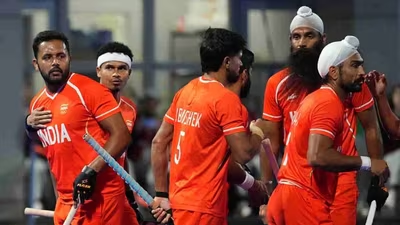
Soon after India crashed out of the Hockey World Cup in August, the team assembled for a post-series review. The morale was at an all-time low, and players were grappling with self-doubt.
I wanted to understand their culture and learn what it takes to play and sustain yourself at the highest level,” midfielder Devindar Walmiki, representing Bharat Petroleum Corporation Ltd, said. “In my opinion, Indian players should experience top-level hockey abroad during their careers. When I left the national team and decided to play overseas, my first goal was to play in the Netherlands, ideally in the top league and the EHL.
The team did well to bounce back, win the Asian Games gold , and book a ticket to the next Olympic games, dominating the competition with 58 goals in seven matches while conceding just eight. That momentum was carried into the Asian Champions Trophy, where they smashed 13 goals past Bangladesh in their tournament opener on Tuesday. Because i was quietly working towards my goal of playing top-level hockey and returning to the national team, not many people saw what I was doing.
The coach’s instructions on this were clear, and I believe that’s why we were able to do it,” Abhishek told Hindustan Times. In hockey, teams are often given specific scenarios to work on, with players guided through videos and tutorials to improve their man-to-man marking,” midfielder Pawan Rajbhar, currently playing for the Indian Navy in the Murugappa Gold Cup Hockey Tournament, told HT. But hockey as a sport is evolving so fast that often some of the seniors will struggle to match up against some young players, who move brilliantly,” said Pawan.
Head coach Peter Fulton and captain Harmanpreet Singh took responsibility, but they didn’t mince their words either. Some players were shown the mirror and given a reality check. Harsh words were exchanged, stern lessons were delivered. But at the end of the day, this team did what any team must after a crushing World Cup defeat: learn from it and move forward. India forward Abhishek Nain, who has been part of these ups and downs, recalls how important it was for the team and players to regroup after a deflating World Cup campaign in which they suffered comprehensive defeats against top sides such as England, Argentina, the Netherlands and Belgium. “After the World Cup, the Asian Games was our top goal. To do well in Japan, we needed to put the World Cup behind us. Carrying that baggage into the Asian Games would have affected our performance. We had to move forward with a fresh mindset. “More improvement is needed to perform well at the World Cup. Mentally, we need to develop that confidence, and the young players who have come in need more practice. We are doing well in Asia, but several aspects of our game appear weak against bigger teams. Our passing needs work, and we need to learn how to perform better against stronger opposition. We have been struggling at World Cups for years, and coaches and players need to give it a lot of thought. We are falling behind as European teams continue to evolve. “I wanted to continue playing international-level hockey, which is why I decided to spend three years in the Netherlands. I became the first Indian to achieve what I did there, playing in the top league and the EHL. For some players, going abroad is about earning money in the short term. For me, it was about improving as a player. Many Indian players have struggled to last even a full season in European leagues, where the competition is demanding and the season is divided into phases. I completed three seasons, and that was a significant achievement. “We surely need more youngsters in the team. The senior players have served well and the experience they bring to the table is unmatched.
