
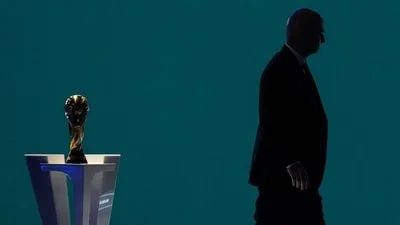
Two weeks after overseeing the men’s World Cup, FIFA President Gianni Infantino is now confronted with the most significant challenge to his position, which had seemed secure until recently.
The Fifa presidential election
A coalition of European football associations has made a public commitment to withdraw their support for the re-election of Gianni Infantino, set for March 2027. Three of football’s six regional confederations—Uefa from Europe, CONCACAF from North and Central America, and the Asian Football Confederation (AFC)—have expressed objections to Infantino’s administration, particularly following his controversial plan to invite private investors, which ignited global backlash.
The controversy centers around the recently proposed FIFA Forward Enterprise (FFE), a commercial arm that was quickly retracted after its announcement. The FFE was designed to oversee FIFA tournaments, including the World Cups and Club World Cup, and aimed to generate $20 billion by selling a 20% stake to private investors for $4.2 billion.
The pressing question now is whether the 56-year-old Swiss-Italian lawyer, who has been at the helm of world football since 2016, can remain in his position until March 18, when the FIFA Congress will convene in Rabat, Morocco. He was anticipated to be re-elected unopposed for a fourth and final term, extending until 2031.
The English Football Association has urged for a thorough evaluation of FIFA’s leadership and governance, while Sweden’s football body has cited ongoing issues with governance and transparency.
Tensions were evident within FIFA’s Zurich headquarters, where Chief Operating Officer Kevin Lamour criticized the FFE, stating that staff had felt misled and labeling the initiative as a singular personal project. On Tuesday, FIFA Secretary General Mattias Grafström—previously considered a close ally of Infantino—termed the past week a “sad and reproachable series of events,” remarking that “individuals and unfortunate episodes come and go.”
Former Arsenal manager Arsène Wenger, now FIFA’s chief of global football development, distanced himself from the FFE, stating the necessary withdrawal of the project was imperative.
Infantino’s primary support comes from outside Europe. The football federations of Morocco, Qatar, Kuwait, Lebanon, and Sri Lanka have publicly reaffirmed their backing, which Infantino has promoted on his Instagram account. In Africa—home to 54 FIFA members—key figures, including CAF Vice-President Fouzi Lekjaa from Morocco, and FIFA Council members from Egypt, Niger, and Mauritania, have also expressed support. However, the CAF is set to meet on Thursday and has not yet officially positioned itself.
In South America, CONMEBOL, reliant on Infantino to expand the World Cup to 64 teams for 2030, has yet to make a public statement.
FIFA dismissed reports from the New York Post claiming Infantino attempted to contact former President Donald Trump, calling the details “pure fiction,” while a U.S. State Department spokesperson noted there were no plans for Secretary of State Marco Rubio to engage with him either.
According to Article 25.4 of the FIFA Statutes, an Extraordinary Congress can be initiated if at least a fifth of the 211 member associations—43 or more federations—submit a written request detailing agenda items. Upon triggering, this Congress must occur within three months.
Uefa alone, with 55 members, has the capacity to initiate such a meeting. Together, Uefa, CONCACAF (35 members), and the AFC (46 members) represent 136 votes, well exceeding the requirement. Reports from The Times of London indicate these three confederations are determined to challenge Infantino and may consider forming their own competitions if he declines to step aside. CONCACAF, the AFC, and FIFA did not promptly respond to media inquiries about this, while Uefa refrained from commenting.
An Extraordinary Congress is already scheduled for November 23 to confirm hosts for the 2031 and 2035 Women’s World Cups. However, Article 25.5 stipulates that once an Extraordinary Congress is convened, the agenda cannot be modified. This may force opponents to instigate a separate Congress.
FIFA’s statutes state only its Congress has the authority to dismiss a sitting president, not the FIFA Council, which Infantino leads. Although the 37-member Council can call an Extraordinary Congress independently, the power to remove the president lies with the 211 federations.
Uefa has issued a legal caution, sending FIFA a “document preservation letter” that identifies 18 key executives, including Infantino, Wenger, and Chief Financial Officer Thomas Peyer, warning that destruction of records could constitute evidence tampering.
FIFA holds presidential elections every four years during the Congress that follows a men’s World Cup. Candidates must have been active in association football for two of the previous five years and pass an eligibility check from a FIFA committee, securing written endorsements from a minimum of five member associations before the November 18 nomination deadline.
Each federation can support one candidate only, making the current trend of withdrawn support letters significant: each letter rescinded represents a signature not going to Infantino during the vote. Every member association of FIFA holds one equal vote, regardless of its size or stature.
In instances where only one candidate stands, the FIFA Congress can elect the president by acclamation, similar to the elections of 2019 and 2023. However, if multiple candidates run, a simple majority of valid votes cast wins—50% plus one vote of those returned, not necessarily from the full 211 membership. In cases with three or more candidates, two-thirds of the votes are required in the first round, eliminating the lowest-pulling candidate afterwards.
Voting is conducted anonymously, with no bloc voting. Consequently, confederations can recommend choices, yet member federations retain the autonomy to vote as they see fit, a crucial distinction that has influenced prior outcomes. Sheikh Salman bin Ibrahim Al Khalifa entered the 2016 election with the backing of both the Asian and African confederations—purportedly totaling over 100 votes—but ultimately secured only 88.
Since its inception in 1904, FIFA has had only nine presidents, with Infantino being the third since the 1970s. His predecessors, Joao Havelange and Sepp Blatter, combined to hold the position for over 40 years. Following Blatter’s resignation amid a corruption scandal, FIFA imposed a three-term limit on the presidency in 2016, seeking to cap tenure at 12 years. Infantino contends that his initial three-year term should not be counted towards that limit, potentially allowing him 15 years in office.
The last competitive FIFA presidential election took place in 2016 in Zurich, leading to Infantino’s election. He triumphed over four opponents—former FIFA Vice-President Prince Ali bin Hussein, AFC President Sheikh Salman, former FIFA Deputy General Secretary Jerome Champagne, and South African businessman Tokyo Sexwale—garnering 115 votes in the second round to surpass the early frontrunner, Salman. His subsequent elections in 2019 and 2023 were both ratified by acclamation, with expectations for another uncontested election set for April 2026 in Vancouver.
However, the current landscape suggests a shift in dynamics. Victor Montagliani, president of CONCACAF and a FIFA vice-president, is viewed as a potential challenger and is reportedly contemplating a bid. Sheikh Salman has voiced his opposition to increasing the 2030 World Cup format to 64 teams. Uefa President Aleksander Ceferin recently boycotted the World Cup final and has been a key figure in the European challenge against Infantino. Additionally, Norwegian FA President Lise Klaveness has garnered support from Blatter, who proclaimed that the moment is right for a woman to occupy a leadership role.
Infantino has a narrow window of seven months to mend his alliances before the congress in Rabat. His influence, like that of his predecessors Blatter and Havelange, has predominantly stemmed from FIFA’s development grants, which are vital for many smaller federations, particularly in Africa, a system he notably expanded following his ascent to the presidency. His FFE proposal aimed to deliver one-off payments and advantages to member associations, resonating particularly with the smaller federations around the globe.
Team Analysis
Thrive Eternal, an investment entity under Thrive Capital—founded by Joshua Kushner, whose brother Jared is married to Ivanka Trump, daughter of former US President Donald Trump—was expected to be the primary investor. Following the withdrawal of the proposal, Infantino expressed regret for the divisions it caused within the sport. In response to the FFE initiative, Uefa announced that it is “actively evaluating potential legal action, arbitration, and/or regulatory complaints.” While no candidates have officially entered the race yet, the deadline on November 18 is approaching in just 15 weeks, and several names have begun to surface as possible challengers.
What comes next
According to Reuters, five European football federations — England (FA), Wales, Serbia, Sweden, and Finland — have officially retracted their previous endorsements for Gianni Infantino’s re-election. Denmark’s federation, which also did not show support earlier, has confirmed it planned to withhold backing regardless. The Football Association of Wales, the first to withdraw, expressed concerns about ‘recent shortcomings in governance, processes, leadership, values, stakeholder engagement, communication, and sound judgement.’ Infantino’s immediate challenge may not be the election next year, but the potential for an earlier confrontation. Whether he can maintain his majority will hinge on the developments in the coming weeks or months.
source
According to a report by Politico, Nasser Al-Khelaifi, the Qatari sports executive at the helm of Paris Saint-Germain, has been suggested as a possible candidate by several European officials.
