
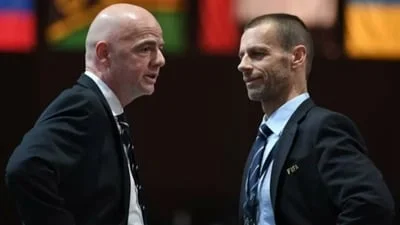
UEFA is set to initiate an independent assessment of FIFA’s previously shelved World Cup investment proposal. This move comes as UEFA escalates its scrutiny of Gianni Infantino’s leadership and investigates whether FIFA was willing to undervalue its future commercial earnings.
Event Context
FIFA proposed to sell a 21% interest in a new commercial entity to a consortium led by Thrive Capital for $4.2 billion, valuing the entity at around $20 billion. This new organization would oversee substantial elements of FIFA’s commercial ventures and tournament operations.
Thrive Capital is run by Joshua Kushner, brother of Jared Kushner, husband to Ivanka Trump, daughter of former President Donald Trump. However, UEFA significantly influenced FIFA’s decision to scrap the proposal within just four days, with all 55 member associations threatening to boycott the World Cup and other FIFA events should the deal proceed.
The focus has shifted from halting the sale to investigating FIFA’s valuation process and whether it maintained transparency and competitiveness before engaging with private investors. Reportedly, UEFA has consulted various market analysts and may initiate a formal independent study once the immediate political backlash against President Gianni Infantino subsides. The sales presentation shared by FIFA recently lacked a comprehensive overview of the valuation methodology or proof that the stake had been put up for competitive bidding.
A source familiar with UEFA’s actions told The Guardian, ‘We need to assess if they were undervaluing the World Cup. How did they arrive at the $20 billion valuation? Was the procedure thorough?’ FIFA generated approximately $15 billion in revenue over the four-year period leading to this summer’s World Cup, prompting analysts to question whether a valuation of merely $5 billion above prospective revenues accurately reflects FIFA’s long-term earning potential.
‘As the World Cup is the only truly global mass entertainment event, an increase of just $5 billion on existing revenues seems inadequate to me,’ the source added. ‘This appears to be a low-ball offer. The potential for financial growth, such as expanding to more teams, more frequent World Cups, or more Club World Cups, is not accounted for.’
Concerns have also been raised that without restrictions on expansion, private investors might pressure FIFA into creating new competitions or enlarging existing ones to maximize commercial returns.
Additionally, UEFA is advocating for a broader review of FIFA’s governance and has hinted at the possibility of legal action. The controversy has revealed significant internal dissent against Infantino, with senior figures like Secretary General Mattias Grafström, Chief Operating Officer Kevin Lamour, and Chief of Global Football Development Arsène Wenger criticizing the proposal’s management.
Infantino later admitted in his apology that the initiative was ‘a mistake.’ Despite this, FIFA has tried to maintain a unified image. After discussions in Morocco, Infantino was seen with Grafström at a Women’s Africa Cup of Nations match, followed by a statement affirming the president’s ‘full support’ from the organization.
While this may have quelled internal dissent within FIFA, external criticism of Infantino continues. UEFA’s forthcoming valuation could reveal whether the World Cup sale was mismanaged or an attempt to offload one of sports’ most valuable assets at a deeply discounted price.
Match Outlook
Despite Gianni Infantino’s written apology to FIFA’s 211 member associations following crisis discussions in Morocco, the European governing body remains unsatisfied. UEFA is likely to persist in its efforts to have him removed and will demand increased financial and governance oversight of the unsuccessful FIFA Forward Enterprise project.
