
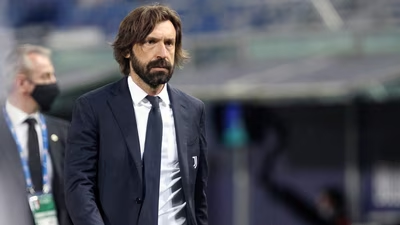
Andrea Pirlo is poised to take the helm as the head coach of the Italy national team, having accepted a verbal offer from the Italian Football Federation. The former Juventus midfielder is set to play a pivotal role in the long-term rebuilding efforts spearheaded by Paolo Maldini and Leonardo.
Event Context
Transfer expert Fabrizio Romano has reported that Andrea Pirlo has approved the proposal and is anticipated to finalize his contract in the next few days as remaining formalities are completed. The contract is believed to extend for four years, possibly lasting until the 2030 FIFA World Cup.
The Italian football federation has yet to make a formal announcement regarding the appointment, which means Pirlo cannot officially be recognized as the coach of Italy until all contractual and administrative procedures are finalized. He is expected to take over from fellow former Italy player Gennaro Gattuso, who departed from the role in April after the national team failed to qualify for the 2026 World Cup. This marks Italy’s third consecutive World Cup absence, having missed out on the 2018 and 2022 tournaments as well.
Pirlo’s appointment signifies a major decision for the newly established technical structure led by Paolo Maldini and Leonardo, who are charged with overseeing a comprehensive reconstruction of Italian football. Initially, the search for a coach included discussions with some of the most prominent names in the industry.
Carlo Ancelotti was approached but opted to remain with Brazil, while former Manchester City manager Pep Guardiola also declined Italy’s offer. Guardiola’s decision was driven by personal reasons rather than financial considerations, preferring to spend time with his family before returning to coaching.
As this process unfolded, Pirlo emerged as the frontrunner. Prior to the agreement, the federation had reached out to him for a four-year term, confirming later on Thursday that the 2006 World Cup champion had accepted the role.
While this appointment represents a notable risk for Italy due to Pirlo’s relatively limited managerial experience, it aligns with the long-term football philosophy that Maldini and Leonardo aim to implement. Pirlo’s managerial journey began with Juventus in 2020, where he led the team to victory in the Coppa Italia and Supercoppa Italiana during his one season at the helm. He then took charge of Fatih Karagümrük in Turkey, followed by Sampdoria, and recently coached United FC in Dubai.
His reputation grew during the latest campaign, as he successfully guided United FC to promotion to the UAE Pro League. This achievement bolstered his credentials at a time when Italy was seeking a coach willing to engage in a broader development initiative rather than simply manage the senior team. Pirlo also boasts an impressive international pedigree as a player, earning 116 caps for Italy and playing a pivotal role in their 2006 World Cup victory, including scoring in the semi-final penalty shootout against Germany and starting the final against France. His return comes at a challenging time for the Italian national team, arguably at one of its lowest points in recent history.
The four-time world champions have not qualified for three consecutive World Cups, and this latest setback has led to significant reforms in the national team structure. Pirlo had previously expressed his concerns about Italy’s decline, labeling their absence from the latest World Cup as “a real disaster” and advocating for a comprehensive rebuild ahead of Euro 2028 and the 2030 World Cup. He now appears poised to undertake that rebuilding effort himself.
Team Analysis
Pending completion of formalities, Andrea Pirlo’s debut as Italy’s head coach is set for September during the UEFA Nations League. Italy will kick off their campaign against Belgium, followed by matches against Turkey and France. However, for Paolo Maldini and Leonardo, Pirlo’s appointment signifies a much broader vision beyond just the upcoming Nations League. He is embarking on a long-term project aimed at revitalizing the national team as they strive to return to the World Cup stage in 2030, following three consecutive tournaments of absence.
