
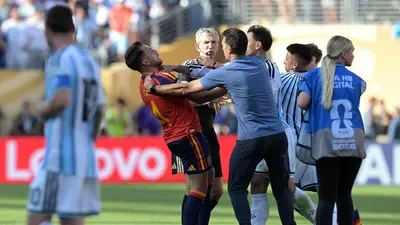
Argentina’s journey in the 2026 FIFA World Cup final ended in disappointment, as the team finished without the trophy, failing to register a single shot on goal. Compounding their woes, FIFA has launched an investigation into players’ participation in a violent altercation after the match. Despite this turmoil, the prevailing sentiment back in Argentina is one of forgiveness rather than reproach.
Event Context
The events at the New York-New Jersey Stadium contrasted sharply with the official statements. After the final whistle, Leandro Paredes clashed with Spanish players, including Eric Garcia and Gavi, igniting a larger altercation between both teams. Players exchanged shoves, necessitating intervention as Scaloni worked to defuse the situation. In response to the brawl, FIFA appointed a disciplinary and ethics prosecutor to conduct an investigation.
Despite the chaos, much of Argentina’s press maintained a protective stance around the team, resulting in an unusual suspension of scrutiny following a final where Argentina was not just defeated but thoroughly outplayed.
The 1-0 scoreline masked the extent of Spain’s dominance, with Luis de la Fuente’s squad outshooting Argentina 20 to 2, hitting 12 shots on target, and accounting for all of the final’s first 20 attempts. Argentina made history as the first team in a World Cup final to finish 90 minutes without a single shot on goal.
Moreover, their two recorded attempts in extra time did not challenge goalkeeper Unai Simón. Emiliano Martinez’s record 12 saves in the World Cup final were crucial in keeping the score level until the 106th minute.
Former Argentine international Marcelo Gallardo suggested that the emotional toll from the semi-final victory over England could explain this performance. “Argentina hadn’t encountered a team like Spain before – one that so effectively took the ball from you and prevented recovery,” Gallardo stated. “They didn’t allow us to play.”
Indeed, Spain’s tactical approach was effective, closing off Argentina’s possession and meaningful attack opportunities. However, attributing Argentina’s shortcomings solely to the emotional aftermath of the England semi-final does not alter the fact that Scaloni’s team was comprehensively outmatched.
Similarly, Argentina’s president, Javier Milei, emphasized the team’s accomplishments, highlighting their journey to three finals in four World Cups and their victory in 2022. “No one can criticize them because they gave everything they had,” Milei remarked.
While Argentina can take pride in reaching yet another World Cup final, this achievement doesn’t shield the final performance from valid critique, and the post-match confrontation cannot be dismissed as an inconsequential detail.
Player Focus
Clarin featured a poignant photograph of a tearful Lionel Messi alongside the headline: “They gave it their all; there’s nothing to blame them for.” The editorial emphasized that, regardless of the outcome, the connection between the Argentine public and its national team had never been as profound as it was this time.
La Nacion commented, “Argentina gave everything, and they are the nation’s pride.” Pagina|12 chose the phrase “From here to eternity,” while the sports outlet Olé referenced the national anthem with the words, “May they be eternal.”
Even this candid reflection concluded that Argentina’s overall performance was “beyond reproach,” highlighting the players’ emotional reactions and their expressions of gratitude toward the fans following the match.
The team’s effort turned into a protective shield, with their tears serving as proof of their integrity. Previous successes were cited as justification, allowing the players to evade a thorough critique of their performance and behavior.
Spain’s domination reduced Argentina to spectators
Following Argentina’s 1-0 loss to Spain in extra time, an Argentine newspaper characterized Lionel Scaloni’s squad as ‘well-mannered and respectful’, minimizing the post-match chaos to just a few ‘regrettable isolated incidents’.
Argentina’s composure had begun to erode even before the final whistle. Enzo Fernández was sent off after receiving a second yellow card for a reckless tackle on Pau Cubarsi, leaving his team a man down just before Ferran Torres netted Spain’s winning goal in the 106th minute.
In a column for Tiempo Argentino, Alejandro Wall highlighted the noticeable gap in performance. He described Spain as ‘a whirlwind of football and determination that dominated Argentina effortlessly’.
Wall noted that Spain held control over possession, created opportunities, and dictated the pace of the match, asserting that Argentina appeared merely to be surviving and looked, based on the statistics, like ‘an inert body’.
Spain maintained their grip on the ball, managed the game expertly, and kept their cool sufficiently to claim the trophy, while Argentina faltered in each aspect.
source
During a heartfelt press conference, Scaloni expressed uncertainty about his future. He remarked, “When the team gives their all as they did today, it sets a powerful example for our nation and its people. It’s difficult to criticize any aspect when they leave everything on the field.”
