
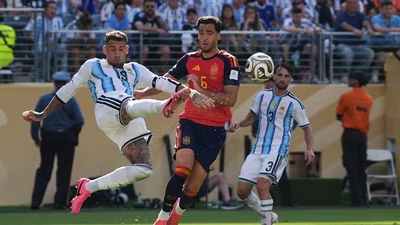
Spain concluded the 2026 World Cup in a fitting position, standing atop the podium with the trophy in hand after a final they dominated for most of the match.
The final exposed the difference
The essence of tournament football lies in its unique structure. Unlike a league season where dominance is measured over months, tournaments hinge on knockout rounds. In these matches, a team can be outplayed or tactically restricted yet still progress through a moment of brilliance, a late goal, a save from the goalkeeper, or a favorable draw.
Consequently, the final may not feature the best two teams of the tournament; it showcases the teams that survived each challenge to reach that stage.
Spain made it to the final by displaying the finest collective performance throughout the World Cup, while Argentina advanced thanks to the extraordinary talent of one player, who propelled an otherwise flawed squad beyond its limitations.
Support for Argentina and admiration for Messi, who, at 39, led his country to another final and delivered an exceptional individual performance, are valid. However, support should not cloud judgment.
Throughout the tournament, Argentina often appeared to revolve around Messi, with the other ten players awaiting his next heroics. Despite their progress, their knockout match results were revealing: they edged out Cape Verde 3-2, defeated Egypt 3-2 after being down 2-0, overcame Switzerland 3-1 in extra time, and beat England 2-1 after coming from behind. Overall, their knockout round record was 11 goals scored to 7 conceded, with no clean sheets across all five matches.
These results speak to their resilience and determination, but they also illustrate the unpredictable nature of knockout football. Argentina didn’t need to dominate the tournament; they just had to survive each match — and they did. Yet, survival should not be mistaken for consistency in performance.
France emerged as the second-best team in the tournament, boasting an average of 7.8 shots on target per game and an xG of approximately 14.3 prior to their semi-final. Their attacking power was notably dispersed among players such as Kylian Mbappé and Ousmane Dembélé. Similarly, England presented a strong case statistically, creating 23 significant opportunities by the quarter-finals, more than any other team, although their defense was less robust than Spain’s or France’s.
Argentina’s win over England deserves respect; ultimately, football is decided on the field, not through analysis. Yet, it does not automatically imply they were the second-best team in the tournament. In the final, against Spain, Argentina failed to register a shot in regulation and lacked meaningful attacking options, highlighting a strategic flaw that stemmed from over-reliance on a single player.
Spain’s strategy was built on teamwork; Argentina aimed to support Messi in the hope that he could deliver victory. While Messi often succeeded in the matches leading up to the final, Spain’s defense successfully neutralized him when it mattered most.
Thus, the two strongest teams did not face off in the 2026 World Cup final; only the strongest team did, and they emerged victorious.
Admiration for Argentina and Messi’s journey to another final is perfectly valid. However, one must acknowledge the facts: when Spain ensured Messi was contained, Argentina did not manage a single shot in regulation time.
This was the final, a telling indicator of their overall tournament performance: Spain first, France second, Argentina third, and England fourth. Argentina earned their place in the final through hard-fought victories, exemplifying the magic of tournament football, but they shouldn’t be labeled among the two best teams of the competition.
Messi and 10 others
Lionel Scaloni’s squad triumphed in every match required to secure their spot in the final, leading the tournament in goals scored and overcoming England in a thrilling semi-final. Their journey to New Jersey was well-deserved, but reaching the final did not simply position them as the second-best team. Rather, it reflected their resilience, often thanks to Lionel Messi’s remarkable ability to navigate through adversity.
The final starkly revealed this reliance. Spain dominated with 65% possession, launched 20 shots, and earned an expected goals (xG) total of 1.94, while Argentina failed to register a single shot during regulation time, their first attempt coming only in the 116th minute. Ultimately, they finished with just two shots, generating an xG of approximately 0.2.
Once Spain effectively neutralized Messi’s influence, which had been crucial in previous matches, Argentina lacked a creative alternative, a coherent attacking strategy, or a unified response. Spain did not just defeat Argentina; they effectively nullified Messi’s impact and exposed the void that followed.
Prior to the final, Argentina had netted 19 goals with an xG of 15.38, while Spain had scored 13 goals from an xG of 14.96. At a glance, these figures could suggest Argentina was the more potent offensive team.
However, when examining the statistics on a per-90-minute basis, Spain’s superior attacking play and territorial control become apparent. Argentina’s passing total was slightly better due to their additional hour of play, but Spain attempted nearly 34 more passes, completed about 30 extra, and forced over 10 more turnovers. They also took more shots and had a higher expected goals tally.
These numbers reflect more than just possession; they illustrate a replicable method of play. Spain exhibited territorial control, aggressive ball recovery, fluid movement that stretched opponents, and chances derived from a cohesive team approach. Their excellence did not hinge on a single player consistently producing moments of brilliance.
Argentina’s main advantage lay in their finishing ability. They managed to score 19 goals against an xG of 15.38, outperforming expectations by 3.62 goals, while Spain came in nearly two goals shy of their xG total by the time of the final. However, even this advantage loops back to Messi.
Messi concluded the tournament with eight goals and four assists, contributing to 12 of Argentina’s 19 goals—equating to 63.2% of their total output. He took 34 shots, with 19 on target, and had an individual xG of 6.16, making up approximately 40% of Argentina’s expected goals and 42% of their actual goals before the final.
His impact was especially evident during the group stage, where Messi netted six of Argentina’s eight goals—which accounted for 75% of their total. This trend intensified in the knockout rounds.
Messi initiated the scoring against Cape Verde, assisted Cristian Romero against Egypt, and facilitated Argentina’s opening goal in the match against Switzerland. In the semi-final versus England, he provided crucial assists for both the equalizer and the stoppage-time winner.
Argentina scored 11 knockout goals prior to the final, with Messi directly influencing six—a figure that still undersells his significance. Most critical phases of play were initiated by him. When the team struggled to achieve offensive progress, Messi moved deeper to help; when they struggled to find creativity, he delivered it; and when they faced defensive issues, he stepped up to make amends.
Argentina boasted capable players such as Emiliano Martínez, Cristian Romero, Alexis Mac Allister, Enzo Fernández, and Lautaro Martínez, but often their roles revolved around Messi’s orchestrations rather than independent contributions.
Passes from Messi led to key moments, exemplified by Fernández’s equalizer against England and Lautaro’s winning goal. Messi was pivotal; the others merely executed.
Thus, characterizing Argentina as ‘Messi and 10 others’ isn’t an exaggeration but rather an acknowledgment of their over-reliance on him for offensive solutions. A team can be structured around a great player without depending on him for every answer, yet Argentina repeatedly crossed that line during the tournament.
In contrast, Spain showcased a more diverse model of play. Mikel Oyarzabal was their leading scorer with five goals, representing only 35.7% of their total. They benefited from contributions across the team, with Dani Olmo and Marc Cucurella each providing two assists, while other players controlled possession or defended robustly. Spain’s threat came from various sources, allowing them to adjust dynamically when needed. Argentina lacked that flexibility; losing Messi meant losing their entire attacking identity.
Argentina’s impressive statistics—19 goals and seven consecutive victories—highlight their efficiency and resilience when Messi found his rhythm. However, unlike Argentina, France wasn’t tethered to a single player and yet struggled against Spain, which stifled their attack, yielding just 0.3 xG and winning 55.9% of duels.
This is the beauty of tournament football: a superior team can be halted by a single counterattack, and a struggling side can prevail due to a goalkeeper’s stellar save. During the tournament, Messi consistently offered Argentina solutions that their team structure failed to produce. Spain’s objective in the final was clear: limit Messi’s impact, intercept his passes, and compel other players to step up. They accomplished this.
Argentina excelled in scoring but was overwhelmingly dependent on Messi, who was involved in nearly two-thirds of their goals and shaped key moments throughout the knockout stages.
France were Spain’s closest challengers
The situation with Argentina was more intricate.
Argentina netted five more goals than Spain, but their defensive record was considerably weaker, conceding eight times as many goals. Spain secured their status as world champions by allowing just a single goal across eight matches, achieving clean sheets against Cape Verde, Saudi Arabia, Uruguay, Austria, Portugal, France, and Argentina, with Belgium being the only team to find the back of the net against them.
This impressive record stemmed not from a defensive mindset, but rather from Spain’s dominance in matches, which often left their opponents struggling for territory, possession, and the passing opportunities needed to create effective attacks.
The distinction became even more pronounced in the knockout stage, where Spain triumphed over Austria 3-0, Portugal 1-0, Belgium 2-1, France 2-0, and Argentina 1-0, resulting in an aggregate score of 9-1. They maintained four clean sheets and did not require extra time until the final match.
Spain dictated the pace of their games, while Argentina often managed to escape their grasp. The caliber of opponents also played a significant role.
Spain’s final four challengers—Portugal, Belgium, France, and Argentina—were all defeated, with Spain conceding only one goal in those encounters. In contrast, Argentina faced Cape Verde, Egypt, Switzerland, and England in their knockout matches, with England being the only true heavyweight among that group. While Argentina’s path to the final was valid, it was evidently less challenging than Spain’s journey.
Additionally, playing time is an important factor in this analysis. Argentina had already endured two extra-time periods—60 extra minutes—in their matches against Cape Verde and Switzerland, whereas Spain completed all seven of their matches leading up to the final within regulation time.
Tournament format doesn’t always reflect the two most well-rounded teams. Instead, it reveals which teams can navigate the bracket, manage pressure, and seize critical moments. Argentina advanced largely thanks to Lionel Messi’s ability to deliver in those moments.
Spain distinguished themselves as the most cohesive team in the tournament by a significant margin. They generated more expected goals (xG) and attempts per 90 minutes than Argentina, and once playing time was equalized, they attempted and completed more passes, forced many more turnovers, and allowed just one goal throughout eight matches.
Spain was a remarkable team featuring several exceptional players, while Argentina was an imperfect squad largely bolstered by the presence of one legendary footballer. Too often, Argentina appeared as a team of individuals reliant on Messi to resolve potential crises, rather than functioning as a unified unit.
